

As a speech language pathologist, you see dozens of patients and every now and then the documentation guidelines change and become more stricter. Your administrative burden is increasing day-by-day and you spend hours every day on filling speech therapy SOAP notes template. Between achieving the ultimate efficiency and scaling your practice with the rising demand of your practice, the thing that is sacrificed is your personal time.
In order to achieve better time management and reduce SLP paperwork, you need to take various steps. This guide outlines the practical and easy to take steps for scaling SLP caseload and reducing the time you spend on every paperwork by half. This blog contains provider-centric strategies to accelerate your clinical efficiency and manage your workflow without going through burnout. By the time you reach the end, you will be able to eliminate the endless cycle of data entries on a permanent basis.
The Hidden Cost of Documentation Burnout
The documentation burnout creates many obstacles in your revenue cycle and has far-reaching impact on your practice’s efficiency:
The Reality of “Time Poverty”
One of the biggest negative outcomes of documentation error and inefficiency is going through the phase known as “Time Poverty”. This means for modern SLPs, spending more time than required for SOAP notes preparation. For school-based practices, this often means unpaid overtime, disturbing the balance between your personal and professional life.
Protecting Quality of Care
Documentation burnout is just limited to overtimes and excessive paperwork, it affects your potential for providing quality of care to patients. When language pathologists spend almost half of their clinical time in paperwork and data collection, it drains their energy, leaving them tired and frustrated with patients. Clinical judgement can also suffer from erroneous assessment, may result in delayed clinical outcomes or improvement in quality of life for the patients.
4 Time-Saving Documentation Tips for the Modern Language Pathologist
The following four strategies will help you overcome documentation issues while also managing caseloads:
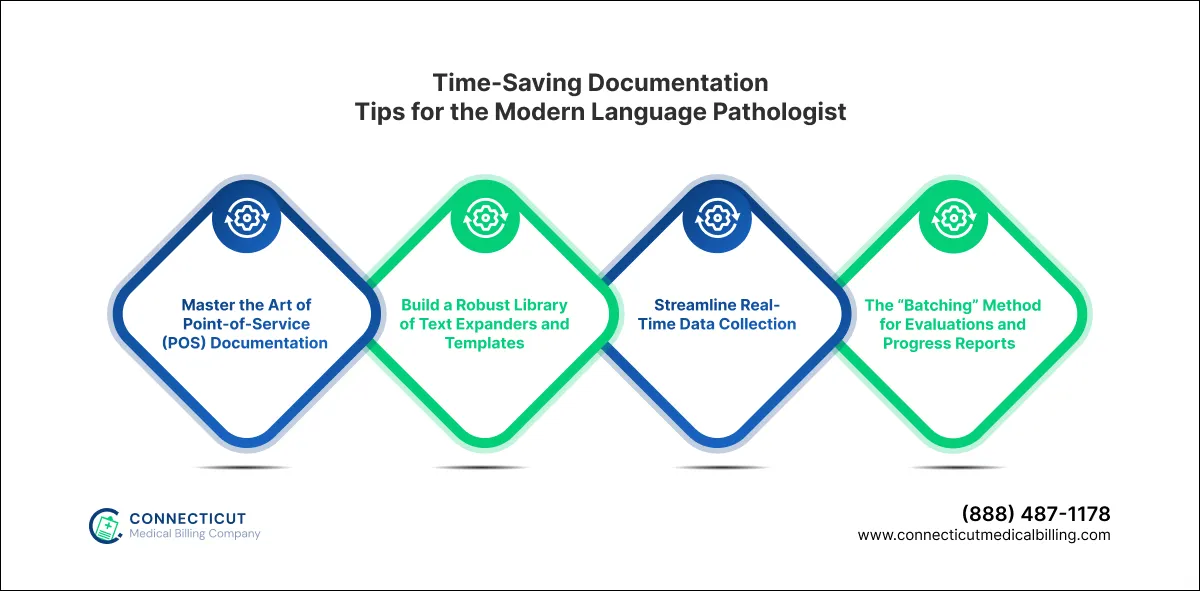
Master the Art of Point-of-Service (POS) Documentation
Patient data collection for language pathologists is one of the biggest challenges. Saving all the day’s session notes to be processed before leaving your office is a recipe for disaster. Make a habit of choosing the last 3-5 minutes of the therapy session for note taking.
Also, educate your patients that it is a part of the session so that you can note the improvements in the patient’s life and set new goals in the action plan. This proactive and useful approach reduces the documentation processing workload to almost zero, preventing any memory gap that may arise at the end of the day.
Build a Robust Library of Text Expanders and Templates
Nothing is more tedious than typing the same clinical phrases in diagnostic and treatment. If the patient you are treating has the same underlying medical condition and doesn’t develop new problems, then your notes will be the same as you created them previously. The solution to these repetitive words and phrases is to use tools like TextExpander or AutoText.
These softwares not only recognize the pattern of words and sentences, they also recommend multiple options so you can choose the best fit. This way you can save your valuable time that would be otherwise spent on writing the same notes over and over again. You can also create a standard template for initial E/M visits and discharge summary to fasten the entire workflow.
Streamline Real-Time Data Collection
Many speech language pathologists (SLPs) still rely on tally markers that make data entries like a lengthy battle. You can adopt a simplified visual tracking method like color-coded sheets or a much better option like Google Form for synchronized data access to all mobile devices and laptops, etc. Doing this will make the entire data collection exercise seamless and you will be able to match the data with patient improvement metrics easily.
The “Batching” Method for Evaluations and Progress Reports
Detailed patient evaluation reports require deep focus from the providers who are already deprived of this luxury. Create a dedicated 45-60 minutes block of time in your weekly schedule for progress summaries when you are totally free and able to devote full attention. Doing this will help you process the reports in batches and even accelerate the process because you are not attending patients.
This method provides benefits in terms of qualitative documentation and comprehensive interpretation of entire symptomatology of the disorders. You will be able to transform your workflow by approaching each task in batches, creating a perfect personal and professional life balance.
Leveraging Tech to Scale Your Caseload Safely
Managing SLP caseload requires a multi-dimensional approach and doing it manually in today’s tech-driven era create obstacles that slows down the entire revenue cycle:
EMR/EHR Optimization
Scaling your SLP practice without Investing in the speech therapy-specific EMR/EHR platform can only increase your admin work. Choosing a tailored EHR suite that offers rapid billing, eligibility verification, and SOAP note templates to be filled easily can be a game changer for your practice.
Utilizing such tools minimizes the data redundancy, and improves compliance at every stage of revenue cycle management. You can reduce your documentation workload and billing errors significantly by using such options. This will ultimately reduce the specific work hours you have devoted for non-patient tasks by half.
The Role of AI Assistants
In the modern healthcare industry the role of artificial intelligence has completely changed the way of documentation and revenue cycle management. Automating your billing workflow with HIPAA-compliant AI medical scribes with dedicated listening software will transform your clinic in many ways. These tools are customizable, to capture all the session details by voice command, allowing you to focus on the patient only, while these software add all the details in your notes. You can achieve a perfect balance of administrative efficiency and clinical outcomes by using AI-powered SLP tools.
Conclusion
Documentation efficiency is a core component of a healthy revenue cycle. Maintaining efficiency is not difficult once you know which department in your clinic is not performing well. The strategies we mentioned here provide you a holistically view of how speech language pathologists can achieve clinical excellence.
Choosing any one or two steps we mentioned above can change the entire outcome of your practice. Whether you choose to master point of service documentation, use of text expanders, EHR/EMR automation or batching technique, each of these strategies will improve your clinic’s documentation methodology. By reducing your administrative burden, quality of patient care services can be improved significantly without compromising your work life balance.
Is your SLP practice facing documentation issues and it’s becoming a nuisance for your billing team, contact Connecticut Medical Billing for seasoned staff having years of experience in documentation management for language pathologists. Get your free quote today.