
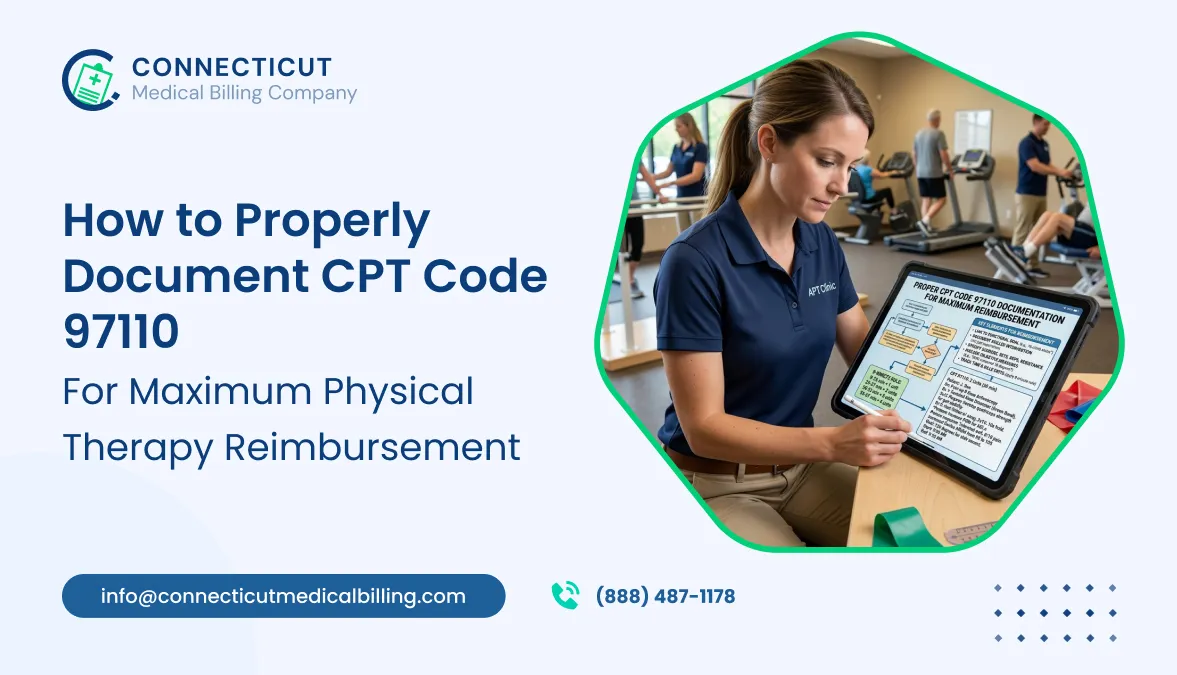
CPT code 97110 is one of the commonly billed therapeutic exercise CPT codes in physical therapy and that’s why it’s most scrutinized by the payers. When practices do improper medical documentation or add vague or repetitive notes, such as “patient did leg presses,” payers downcode or reject the claim altogether.
On the other hand, when physical therapy practices do strong and objective documentation, it becomes their ally to support medical necessity, demonstrate skilled care, and guarantee full payment for every minute of clinical time provided. This guide highlights the accurate CPT 97110 description and it can be used to make daily claim submission audit-proof. This blog empowers your billing teams to thoroughly understand the 8-minute rule 97110 code allows and how you can secure appropriate physical therapy reimbursement for clinical time.
CPT Code 97110 Essentials: Definition & Billed Scope
Understanding CPT 97110 billing guidelines and its use is fundamental to capture the full extent of physical therapy reimbursement.
Official Definition
The clinical intent of CPT 97110 is to cover physical therapy exercises offered by a certified physical therapist to develop strength, endurance, range of motion (ROM), and flexibility through direct, one-on-one patient contact. This code is billed in 15-minute timed units and an encounter must last a minimum of 8 minutes to be charged to insurance.
Clinical Intent vs. Overlapping Codes
It’s important for therapists to understand and use therapeutic exercise CPT code according to the intervention’s clinical purpose. 97110 vs 97112 (Therapeutic Exercise vs. Neuromuscular Re-education) both cover interventions but there’s a subtle difference between them.
CPT 97112 generally applies to neuromuscular re-education involving balance, coordination, or proprioception, while 97530 covers functional, dynamic therapeutic activities rather than exercises targeting specific physical parameters.
The CMS 8-Minute Rule
Timed code physical therapy like 97110 demands strict adherence to Medicare’s 8-Minute Rule. Thus, a provider must perform at least 8 minutes of direct, continuous skilled care to bill one unit.
Essential Documentation Elements for Full Reimbursement
Defensible documentation PT demands clear and undisputable evidence of medical necessity for therapeutic exercise to achieve precise objective metrics to improve the quality of life for the patients.
Establish Medical Necessity and Clinical Justification
In order to reduce commercial payers and Medicare rejections, link the therapeutic exercises directly to functional deficits identified during the first evaluation. For maximum physical therapy reimbursement rates, frame exercise selection around functional limitations, for instance, explain how restoring quadriceps strength reduces pain during stair navigation or sit-to-stand transfers.
Recording Specific Objective Parameters
Treatment notes must explicitly identify and document the exercises performed and measurable parameters to meet the physical therapy daily note requirements.
Exercise Details:
Specific exercises, sets, repetitions, resistance levels, or weights used (e.g., quadruped leg lifts, 3×10, with 3 lb ankle weights).
Target Joint or Body Region:
Must document the exact anatomical area like shoulder, hip, knee, or ankle receiving treatment.
Direct Supervision:
Documentation must include direct one-on-one intervention by the therapist or therapy assistant when applicable. These specific details make billed units easier to substantiate during payer review.
Demonstrating Skilled Care Interventions
Commercial payers and Medicaid downcode any claim if the clinical documentation fails to establish medical necessity for therapeutic intervention that sounds more like an unsupervised gym routine. Documentation must be solid enough to show why a physical therapist’s expertise was necessary:
- Unskilled (Avoid): “Patient completed 3×10 leg press at 50 lbs.”
- Skilled (Use): “Tactile and verbal cues provided for knee alignment during 3×10 leg press at 50 lbs to prevent valgus collapse and protect joint integrity.”
The Skilled care documentation examples mentioned above clearly demonstrate the expert clinical observation, corrective intervention, and skilled involvement supporting CPT 97110 documentation requirements.
Document Progress and Patient Response
Providers must also record how the patient responded to treatment using measurable findings such as pain ratings, Rate of Perceived Exertion (RPE), exercise tolerance, and functional progress. Similarly, you must note key findings during the session like changes in resistance, repetitions, positioning, or technique to comply with physical therapy documentation guidelines.
Common Documentation Pitfalls That Lead to CPT 97110 Denials
Weak documentation can become a pitfall for experienced physical therapy providers where if small errors are overlooked can trigger claim denials and post-payment audits. It is imperative for physical therapy providers to avoid the following four common billing errors for reducing physical therapy claim denials.
1. Cloning or Copying Daily Notes
When medical billers cut short the billing process by copy-pasting provider notes, the claim fails to demonstrate the patient’s changing condition and treatment progression. Patient documentation must establish changes in resistance, repetitions, exercise tolerance, therapist cues, and patient response. Doing this creates a clearer record of ongoing skilled care that satisfies payers’ audit team.
2. Using Vague Exercise Descriptions
Supporting physical therapy CPT codes with vague phrases or statements like “patient tolerated exercises well” or “worked on leg strength” provide zero measurable proof of medical necessity. Your clinical notes should be filled with objective parameters, quantifiable feedback, and documented patient adaptations to strengthen 97110 documentation.
3. Incorrectly Documenting Timed Units
It’s important for practices to accurately record therapy minutes because 97110 is a timed therapeutic exercise code. Every therapeutic intervention under the CMS 8-Minute Rule must include distinct time logs, otherwise it creates serious compliance risks.
4. Missing the Functional Connection
Physical therapy exercise documentation should be sound and detailed to demonstrate how clinical improvement supports functional goals for the patient. Details like increased lower-extremity strength may improve transfers, walking tolerance, or stair climbing create a bridge between therapeutic exercise and functional independence. When these details are added in the documentation, they result in appropriate reimbursement.
Quick Reference Checklist for Physical Therapists
The following checklist ensures every time you sign the daily treatment notes, the claim is audit-ready, consistent and detailed to support CPT code 97110 billing, medical necessity, and appropriate reimbursement.
CPT 97110 Documentation Checklist
- Skilled intervention noted? Document therapist cues, supervision, or clinical decision-making.
- Timed minutes accurately recorded? Capture treatment time supporting each billed 97110 unit.
- Objective details specified? Include exercises, sets, repetitions, resistance, and targeted body region.
- Functional relevance stated? Connect therapeutic exercise to measurable functional limitations and goals.
- Progression or modification logged? Record changes in resistance, technique, tolerance, pain, or exercise complexity.
Key Takeaway
The use of accurate CPT code 97110 for physical therapy is not important for compliance, it also helps you transform daily charting into your practice’s strongest financial defense. When therapeutic exercises are backed by evidence and improvement in functional movements, it shows payers that intervention by a physical therapist is working as intended and the patient is experiencing a better quality of life.
It’s a vital responsibility of your billing team to audit documentation of claims monthly to find the gaps and leakages. Doing so ensures every billed unit yields full reimbursement for your expertise.
Get a free billing audit from Connecticut Medical Billing to match your documentation and billing habits to see where your in-house team is lagging behind. Our RCM staff is trained in optimizing your revenue cycle and help you comply with CMS 8-minute rule for maximum reimbursement.