
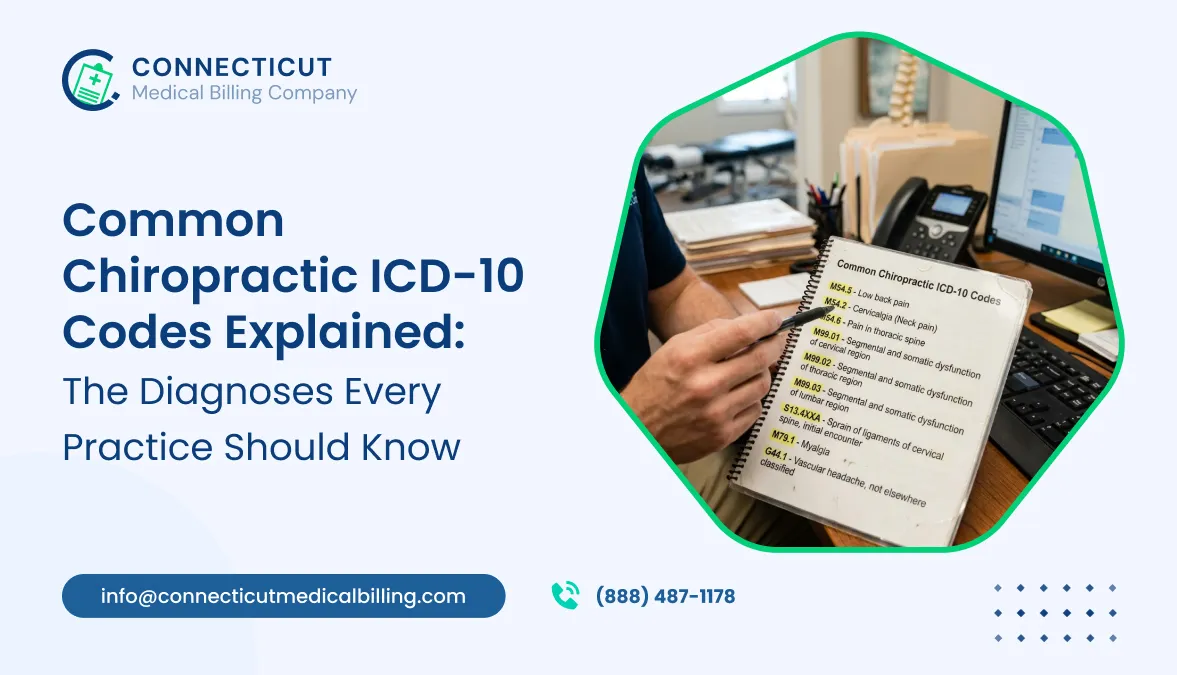
In healthcare practices a gap always exists between clinical delivery and financial recovery. While many Chiropractic providers are content with excelling in patient care, the documentation gap like an imprecise diagnostic code can reduce a legitimate spinal manipulation claim to an automated denial.
To cut short, medical billers turn their reliance on M54.50 for general low back pain that signals weak medical necessity to clearinghouse algorithms, instantly flagging claims for downcoding or audit reviews. Accuracy in medicare chiropractic diagnosis codes is even more important for Connecticut chiropractors who have to manage varying demands of major area payers like Anthem BCBS CT, ConnectiCare, Harvard Pilgrim, and National Government Services (Medicare Region-1).
Whether you’re running a solo chiropractic clinic or in group practice, this guide will help you understand the most common chiropractic diagnosis codes and how to apply them. By integrating accuracy you can accelerate reimbursement without endangering your hard-earned revenue and prevent denials.
Segmental & Somatic Dysfunction (M99 Series): The Foundation of Chiropractic Billing
Among all chiropractic diagnosis codes, the M99.01 to M99.05 segmental dysfunction series carries a significant importance. Segmental dysfunction ICD 10 codes represent the non-negotiable primary subluxation diagnoses required by Medicare Region 1 (NGS) and major commercial payers across Connecticut. Using these codes help chiropractors establish the baseline medical necessity for Chiropractic Manipulative Treatment (CMT—CPT 98940 through 98942).
It’s also essential to know that, without an explicit M99.0x code indicating the exact anatomical site of subluxation, clearinghouses will automatically reject or downcode spinal manipulation claims. The following is the chiropractic ICD 10 cheat sheet for M99.0 series.
Anatomical Breakdown of M99.0 Subluxation Codes
As per the latest chiropractic billing and coding guidelines, your primary ICD-10 code must mirror the exact anatomical region treated:
M99.00 (Head/Occipital Region)
Segmental dysfunction of the occiput, temporomandibular joint, or cranial sutures.
M99.01 (Cervical Region)
Subluxation complex of C1 through C7 vertebrae.
M99.02 (Thoracic Region)
Segmental dysfunction affecting T1 through T12 and associated costovertebral joints.
M99.03 (Lumbar Region)
Subluxation complex of L1 through L5 lumbar vertebrae.
M99.04 (Sacral Region)
Segmental dysfunction of the sacrum, including sacrococcygeal connections.
M99.05 (Pelvic Region)
Subluxation or structural asymmetry of the ilium, ischium, pubic bone, or sacroiliac joints.
Provider Documentation Tip: Validating M99.0 Codes with the PART Criteria
Beside selecting the correct M99.0x codes, providers must also utilize the PART exam framework to document at least two of the following four physical criteria in your daily S.O.A.P. notes, with at least one being A (Asymmetry) or R (Range of Motion):
- P — Pain / Tenderness: Documented via palpation or provocation testing (e.g., local tenderness at L4–L5).
- A — Asymmetry / Misalignment: Observed visually or via static palpation (e.g., high left iliac crest or rotated spinous process).
- R — Range of Motion Abnormality: Measured restriction during active or passive movement (e.g., decreased lumbar flexion).
- T — Tissue Texture Changes: Soft tissue alterations identified through palpation (e.g., paraspinal hypertonicity or edema).
Spine Pain Categories (M54 Series): Unlocking Specificity for Full Reimbursement
Subluxation codes help practices establish the structural justification for spinal manipulative therapy but accurate symptom-based diagnosis codes strengthen the medical necessity for ongoing care. M54 dorsalgia category code covers almost all spinal pain conditions presenting to chiropractic clinics throughout Connecticut. However, relying on generic back pain codes without specifying the exact location of the pain and medical reasons for the onset triggers claim audits and delays reimbursement.
When practices align the highly detailed M54 codes with primary M99.0x subluxation diagnoses codes, it helps pain management clinics to explicitly demonstrate clinical complexity to payers like Anthem BCBS CT and ConnectiCare. Airtight clinical documentation safeguard your practice from post-payment recoupments while ensuring your passive and active therapeutic modalities get paid without resistance.
Beyond Generic “Back Pain”: Highly Specific M54 Coding Upgrades
CT Medicaid chiropractic ICD 10 rules demand practices to move away from unspecified diagnoses and choose a diagnostic coding that precisely reflect the clinical exam and regional pain presentations:
M54.2 (Cervicalgia)
Primary neck pain without radicular symptoms or intervertebral disc displacement.
M54.6 (Pain in Thoracic Spine)
Mid-back axial pain, often accompanying thoracic subluxation (M99.02) or postural stress.
Low Back Pain Specificity Shift
Transitioning away from M54.50 (Unspecified low back pain) to clinically precise descriptors:
M54.51 (Vertebrogenic Low Back Pain)
Specific to endplate structural changes and vertebral body pathology.
M54.59 (Other Low Back Pain)
Non-specific low back strain or axial lumbar discomfort with documented anatomical localization.
Lumbago with Sciatica (Laterality Required)
Lower back pain radiating down the sciatic nerve trajectory:
M54.41 (Lumbago with Sciatica, Right Side)
Radiation into the right lower extremity.
M54.42 (Lumbago with Sciatica, Left Side)
Radiation into the left lower extremity.
Claim Linking Rules: Pairing M54 Symptom Codes with M99 Primary Diagnoses
In order to prevent automated claim scrubbing tools, you must ensure the diagnostic hierarchy on the CMS-1500 claim form (Box 21) must strictly follow medical necessity linkage rules:
Line-Item Diagnostic Pointer Rules
Always list the primary structural subluxation code (M99.0x) in Position A (Diagnosis Pointer 1). Place the corresponding M54 symptom code in Position B (Diagnosis Pointer 2).
CPT-to-ICD Linking Strategy
- Link Chiropractic Manipulative Treatment (CPT 98940–98942) directly to the primary M99.0x subluxation code.
- Link supportive modalities, such as Mechanical Traction (CPT 97012), Neuromuscular Re-education (CPT 97112), or Therapeutic Exercise (CPT 97110) to secondary M54 symptom and radiculopathy codes.
Regional Consistency
Primary subluxation code and secondary pain code must match automatically. For example, pairing Cervical Subluxation (M99.01) exclusively with Low Back Pain (M54.51) on the same line will result in payer flagging the claim for error, prompting automated rejection.
Disc Disorders, Radiculopathy & Nerve Impingement: Substantiating High-Complexity Chiropractic Care
Billing precision becomes more critical when routine subluxation moves into management of complex disc pathologies and spinal nerve compressions. Payers like Anthem BCBS CT, ConnectiCare, and Medicare Region 1 (NGS) heavily audit the claims when treatment involves the conditions like intervertebral disc herniation, spinal degeneration, and active radiculopathy.
Intervertebral Disc Conditions: Displacement vs. Degeneration
Accurate diagnosis of the degenerative disc disorder help make documentation audit-ready and demonstrate whether the underlying pathology is acute structural displacement or progressive mechanical breakdown:
Cervical Disc Pathology (M50 Series)
- M50.20 Other Cervical Disc Displacement (Unspecified Region): Used for acute cervical disc herniation, bulge, or protrusion without radiculopathy. (Note: Specify exact levels such as C5–C6 when advanced imaging is available).
- M50.30 Other Cervical Disc Degeneration (Unspecified Region): Indicates chronic disc height loss, desiccation, or osteophytic changes in the neck without acute protrusion.
Lumbar & Thoracolumbar Disc Pathology (M51 Series)
- M51.26 Other Intervertebral Disc Displacement, Lumbar Region: Indicates lumbar disc herniation, extrusion, or sequestration in L1 through L5.
- M51.27 Other Intervertebral Disc Displacement, Lumbosacral Region: Specific to acute disc displacement occurring at the L5–S1 junction.
Radiculopathy & Sciatica: Documenting Nerve Root Compromise
When coding for nerve damage and corresponding therapies, it’s important to note the objective neurological exam findings (such as altered deep tendon reflexes, dermatomal sensory loss, or myotomal weakness):
- M54.12 Cervical Radiculopathy: Compressed cervical nerve roots presenting with radiating upper extremity pain, numbness, or weakness.
- M54.16 Lumbar Radiculopathy: L4–S1 nerve root irritation resulting in lower extremity neurological deficits.
Sciatica (Requires Unilateral Laterality)
Pain along the sciatic nerve pathway without explicit disc displacement documentation:
- M54.31 Sciatica, Right Side: Radiating pain restricted to the right lower extremity.
- M54.32 Sciatica, Left Side: Radiating pain restricted to the left lower extremity.
Billing Strategy Note: Aligning Imaging Reports with Claims Data
Even when diagnosis and treatment codes match, your claim must mirror the radiologist’s findings. Here’s how you can survive the post-payment audits and pre-payment medical necessity reviews:
The MRI/X-Ray Match
If an MRI report reads “L4–L5 disc desiccation without herniation,” billing M51.26 (Disc Displacement) will result in an audit failure. The record supports M51.36 (Disc Degeneration).
Clinical Correlation Required
Diagnostic imaging alone is insufficient; payers expect S.O.A.P. notes to document positive orthopedic or neurological tests (e.g., Straight Leg Raise, Spurling’s Test) matching the side and level indicated on the image.
Modality Justification
High-tier codes like M54.16 (Lumbar Radiculopathy) or M51.27 (Lumbosacral Disc Displacement) are necessary to justify non-covered or pre-authorized supportive therapies like Mechanical Decompression (CPT 97012) or Active Rehabilitation (CPT 97110).
Soft Tissue, Muscle Spasms & Postural Disorders: Justifying Ancillary & Active Therapies
A successful chiropractic medical billing Connecticut rarely relies on spinal manipulation alone. The responsibility falls on provider shoulders for full restoration of spinal mechanics including treatment of surrounding soft tissue structures, relieving myofascial tension, and correcting underlying structural postural deviations. Here’s how you can ensure 100% compliance with chiropractic ICD-10 codes:
Myofascial Pain & Soft Tissue Disorders: Capturing Local Muscular Pathology
When you document soft tissue impairment, it’s important to go beyond the typical vague descriptions to pinpoint the exact physiological presentation:
M79.10 Myalgia, Unspecified Site
Use it to indicate generalized muscle pain, myofascial trigger points, or soft tissue soreness without localized inflammation.
M62.830 Muscle Spasm of Back
Apply this highly specific code when a patient is experiencing involuntary, painful contractions of the paraspinal, latissimus, or rhomboid musculature.
Clinical Distinction
Use M62.830 when palpable muscular hypertonicity or guarding is actively demonstrated during physical examination.
Postural & Structural Deformities: Documenting Chronic Biomechanical Stress
When the condition like chronic spinal misalignment and postural adaptation alter load distribution are present, these symptoms require extended rehabilitative care plans:
M41.9 Scoliosis, Unspecified
Lateral curvature of the spine driving compensatory muscular imbalance and lateral joint shearing.
M40.0 Postural Kyphosis
Excessive anterior curvature of the thoracic spine resulting from chronic postural deconditioning or upper crossed syndrome.
R29.3 Abnormal Posture
Forward head posture, pelvic tilt, or functional spinal asymmetries impacting movement biomechanics.
Modality Linkage Rules: Supporting CPT 97110, 97112 & 97140 Beyond Adjustments
For an error-free claim submission, it is important your claim must link the CPT codes to these soft tissue and postural secondary diagnoses:
Manual Therapy (CPT 97140)
Manual therapy code must be linked directly to soft tissue impairment codes such as Myalgia (M79.10) or Muscle Spasm (M62.830).
Billing Tip:
Always append Modifier 59 or XS when billing 97140 alongside CMT (98940–98942) to demonstrate manual therapy was performed in a distinct anatomical region or separate time window.
Therapeutic Exercise (CPT 97110)
Pair with postural deformities (M41.9, M40.0) or chronic muscle weakness to justify 15-minute unit increments focused on strengthening and range-of-motion recovery.
Neuromuscular Re-education (CPT 97112)
Link to Abnormal Posture (R29.3) or severe radicular motor compensation to support proprioceptive, balance, and movement pattern re-training.
Acute Traumas, Sprains & Auto Injury (S-Codes): Managing High-Stakes Personal Injury Claims
Motor vehicle accidents (MVA), occupational injuries, or sudden traumatic events require providers to adopt a different diagnostic coding approach like transitioning from M series codes to S category codes (Injury, Poisoning, and External Causes).
Primary Acute Spine Trauma Codes: Defining Ligamentous Sprains
The S category codes that you must use for care services related to acute spinal hyperflexion/hyperextension injuries (whiplash) and sudden lifting traumas are following:
S13.4XXA Sprain of Ligaments of Cervical Spine (Initial Encounter)
The benchmark diagnosis for acute whiplash, cervical acceleration/deceleration injuries, and acute capsular ligament strain.
S23.3XXA Sprain of Ligaments of Thoracic Spine (Initial Encounter)
Acute mid-back sprain resulting from direct blunt impact, rotational trauma, or sudden seatbelt restraint tension.
S33.5XXA Sprain of Ligaments of Lumbar Spine (Initial Encounter)
Acute lower back ligamentous tearing or sprain stemming from heavy lifting, violent twisting, or rear-end collision impact forces.
Mastering the 7th Character Extension: Tracking Clinical Episode Trajectory
Trauma care services demand rigorous compliance with the mandatory 7th character to communicate the exact phase of care to third-party payers:
A (Initial Encounter)
Used while the patient is receiving active, active-restorative treatment for the acute injury. (Note: Apply A as long as active care continues under the primary treatment plan, not just on the first day of visit).
D (Subsequent Encounter)
This code is applied when the patient has completed active-restorative care and is in routine recovery, passive monitoring, or supportive healing phases.
S (Sequela)
Its use is reserved for chronic late effects or permanent complications directly arising from the original trauma (e.g., post-traumatic cervical osteoarthritis developing months after the initial accident).
Connecticut Auto Injury & Workers’ Compensation Billing Rules
Chiropractic clinics must carefully navigate Connecticut’s unique payer demands that determine the personal injury reimbursement.
Connecticut MVA & Medical Payments (MedPay)
Connecticut operates as a fault-based auto insurance state. Auto policies often include optional Medical Payments (MedPay) coverage, which pays primary medical bills up to policy limits regardless of fault. Billing S13.4XXA or S33.5XXA with clear mechanism-of-injury documentation ensures rapid MedPay disbursement before third-party liability settlements settle.
CT Workers’ Compensation Fee Schedule Compliance
Work-related spine injuries billed to Connecticut Workers’ Comp carriers require strict diagnostic linkage between the CPT code, the S-code, and the Form 30C injury filing.
Transitioning S-Codes to M-Codes
If an acute traumatic sprain (S13.4XXA) transitions into chronic subluxation or myofascial pain beyond normal healing windows (typically 8–12 weeks), documentation must reflect the updated diagnostic pivot to M99 and M54 codes to justify extended therapeutic care.
Key Takeaways
Mastering the nuances of common chiropractic ICD 10 codes is not just administrative exercise, it is the most important step towards precision-driven revenue cycle management. When practices move away from vague clinical notes and align themselves with current regional payer mandates, they make sure every step to protect their cash flow is taken timely and efficiently. Reimbursement follows when the diagnostic hierarchy aligns with the clinical complexity and rendered care.
Are you experiencing consistent billing errors, mismatch coding and claim denials? Partner with Connecticut’s local medical billing experts. At Connecticut Medical Billing, we streamline your chiropractic billing with regional payer mandate to resolve RCM issues. Get your complimentary revenue cycle audit today.