

Revenue cycle management in acute care surgery has always been flawed. When a patient comes with life-threatening symptoms, acute care surgeons’ sole attention is on alleviating their patients. Unfortunately, this is the point where administrative mistakes take hold and clinical documentation fails to show what happened in the operation room. When the emergency general surgery coding is inaccurate, the bill will be either overcode or undercode, resulting in hospital administrative write-offs.
The fix to surgical revenue cycle management (RCM) lies in error-free trauma bay handoff protocol documentation to help practices in reducing claim denials. This proactive approach ensures every claim includes critical care billing CPT codes (specifically targeting 99291 and 99292) and cash flow remains uninterrupted. The blog guide will help you precisely achieve this clinical excellence where earned revenue is safeguarded against retroactive denials.
The Anatomy of an ACS Write-off: Where the Revenue Leaks
The high-risk zone where acute care surgery suffers revenue leakage is the rapid transition from the emergency department to the operation room. This transition zone creates a gap between care provided and ER-to-OR clinical workflow timeline:
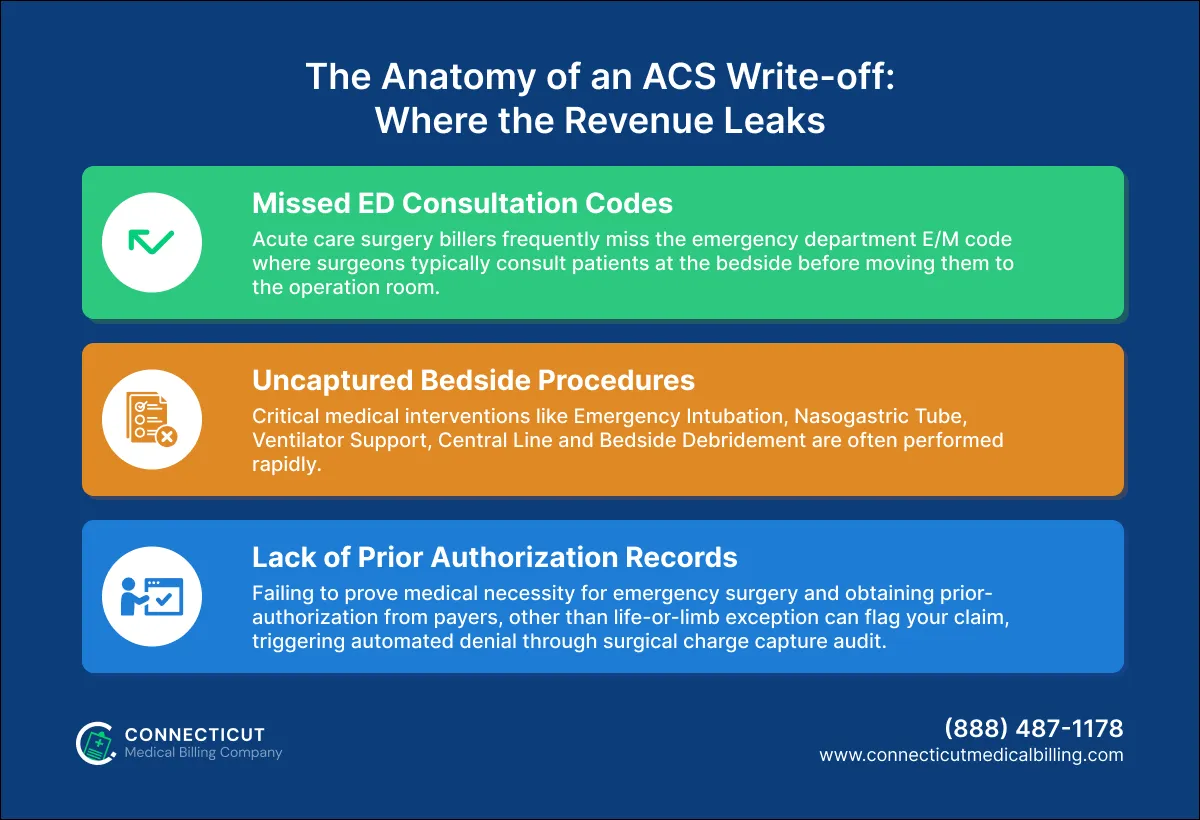
Missed ED Consultation Codes
Acute care surgery billers frequently miss the emergency department E/M code where surgeons typically consult patients at the bedside before moving them to the operation room. On top of this, incomplete or missed trauma activation fee documentation where hospital readies trauma surgeons and trauma bay leave thousands of dollars on the table that weakens the financial strength of the healthcare institution.
Uncaptured Bedside Procedures
Critical medical interventions like Emergency Intubation, Nasogastric Tube, Ventilator Support, Central Line and Bedside Debridement are often performed rapidly. If these details are not added in the dictation report, providers and hospitals lose a big chunk of their revenue.
Lack of Prior Authorization Records
Failing to prove medical necessity for emergency surgery and obtaining prior-authorization from payers, other than life-or-limb exception can flag your claim, triggering automated denial through surgical charge capture audit.
Optimizing Acute Care Surgery Pathways for Revenue Capture
Optimizing ACS revenue cycle management helps practices in preventing retroactive insurance denials with structured and result-driven strategies like the following:
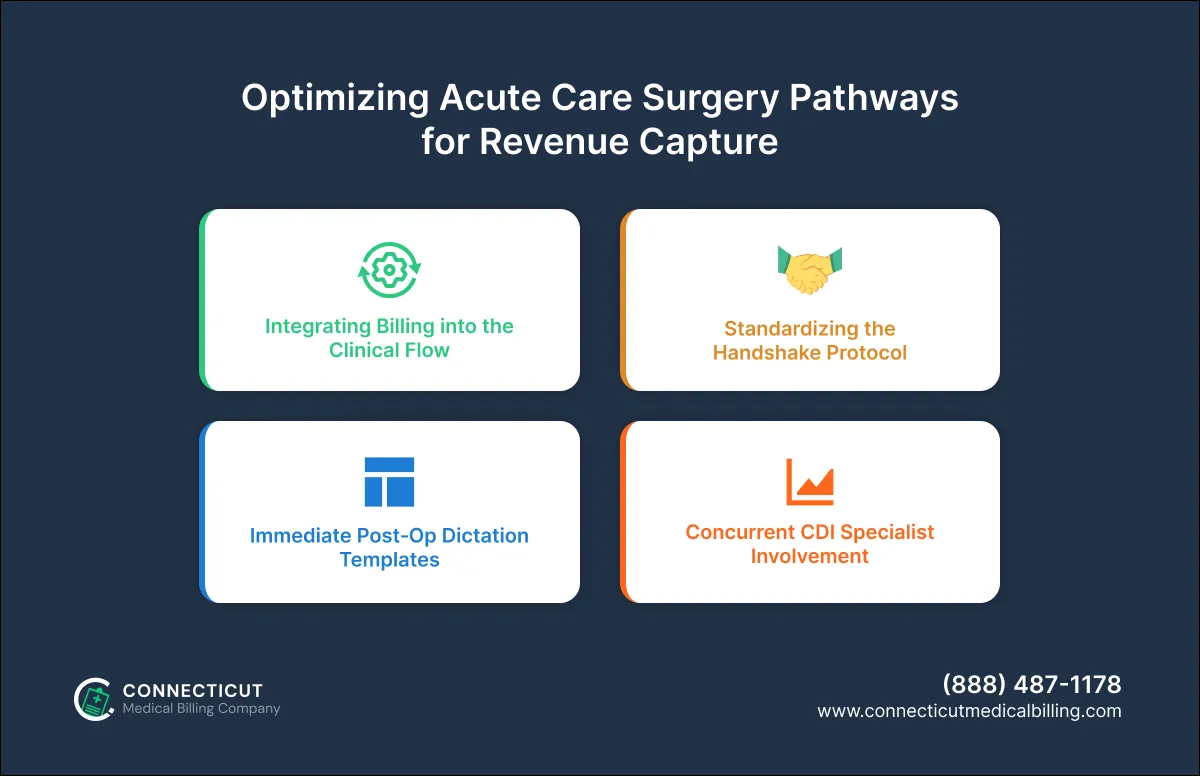
Integrating Billing into the Clinical Flow
Financial tracking of your acute care surgery practice cannot become an afterthought. Your clinical workflow must integrate surgery billing processes to accurately and timely add charge capture for patient care services. Precise clinical documentation by surgeons ensures every consultation and procedure is added in the claim to prevent administrative write-off.
Standardizing the Handshake Protocol
Practices also must maintain and standardize handoff documentation when the patient is physically transferred to the trauma bay, operation room and the surgical ICU. This documentation that must be filled by healthcare professionals before patient transfers to the next department ensures critical details like diagnosis, procedure and on-going rehabilitation support notes are transferred across all departments. Doing this prevents revenue from slipping through the cracks.
Immediate Post‑Op Dictation Templates
Hospital’s general surgery templates rarely capture the true complexity of the post-operative care and treatment protocols. Utilizing surgical EHR smart phrases that have a tailored template for acute care surgery procedures ensures accurate documentation of surgery acuity, presence of assistant surgeons, intraoperative findings and post-operative care.
Concurrent CDI Specialist Involvement
Clinical documentation improvement (CDI) for surgery ensures all the charts are reviewed prior to claim submission. Instead of waiting for days, hospital CDI specialists can audit the acute care surgery charts of the patients within 24 hours of admission to resolve any administrative or front-end errors. Doing this resolves systemic as well as systemic billing errors and increases clean claim rates rapidly.
Taking the above-mentioned steps and integrating them into your ACS revenue cycle strategy ensures you’re paid for every minute spent in patient care.
Streamlining Documentation to Prevent Administrative Losses
Detailed and meticulous clinical documentation is the most important factor for streamlined revenue cycle management. But In acute care surgery it’s far more important and works as a shield against retroactive payer clawbacks. In order to save your practice from payer audits, providers must avoid these following three coding pitfalls that can disturb the entire cash flow for your practice:
Modifier -25 vs. Modifier -57 Emergency Surgery
For spotless medical coding, acute care surgeons must document separately identifiable bedside E/M visits from the procedure. Emergency surgery modifier -25 must be used for evaluation and management performed on the same day as major surgery in the operation room. Any misuse can force payers to downcode your service leading to underpayments.
Securing Teaching Physician Attestations
When the resident or fellow surgeons are involved in the care pathway, it’s essential to add the attending surgeons attestations, ensuring all the care and medical decision making was under their supervision. Payers now require explicit and detailed information of the teaching physicians and their clinical assessment for cases where pre-certified physicians are playing a part in patient care. Providers must comply with this strict teaching physician attestation guidelines to ensure claim is timely processed.
Proving the Medical Necessity Hook
Emergency surgery claims are heavily scrutinized by the payers due to strict medical necessity requirements. Your pre-operative notes must document the medical decision making to show why conservative or non-invasive treatment was not a viable option for such a medical condition. A valid and evidence backed decision making ensures payers understand the justification and reimburse the claim.
Taking these proactive steps to ensure bulletproof documentation strengthens the revenue collection, improving compliance and lowering write-offs. Stronger revenue cycles let providers focus on patient care rather than worrying about claim denials.
Conclusion
The bottom line is simple, your clinical documentation must be detailed, and include all relevant information to stand against payer audits. Insurance will only pay for the services that are documented in the charts and coded precisely. Your practice can only meet the new financial reality of emergency medicine when you integrate billing in your clinical workflow, use smart EHR templates, and utilize the services of CDI specialists for claim audits.
Additionally, when you accurately separate E/M visits from major surgeries, secure attending physician attestation, and document medical necessity, you remove all the reasons payers can use to deny your claim. Are you ready to stop administrative write-offs? Start auditing your last 50 acute care surgery claims today and see how many services are unbilled. Each missed entry is the lost revenue you deserved but left it on the table. Optimize your acute care surgery pathways today and safeguard your practice from costly clawbacks that are draining your efforts and revenue.
Is your surgery practice going through low collections and payers frequently disrupt your cash flow? Get Connecticut Medical Billing to sort your documentation, administrative and low collection issues. Our skilled team works closely with all top payers in Connecticut and expedites claim processing to increase your cash flow. Book your free appointment today.