

Hypothyroidism is a medical condition that the world’s 5% population is suffering from. It is treated as a routine medical care but its documentation can become a big headache for endocronologist and ENT surgeons. One of the common pitfall or cause of provider/payer frinction is ICD-10 E03.9 (Hypothyroidism, unspecified).
Although it is frequently used Hypothyroidism ICD 10 code, yet it is the most scrutinized code by the payers and auditors. In this guide, we will delve deep into how practices can master the use of ICD 10 E03.9 code efficiently and get paid without going through external or retroactive audits. Read this high-yield cheat sheet and safeguard your revenue starting from today.
Understanding E03.9: When to Use (and Avoid) the “Unspecified” Tag
For providers, it’s essential to understand how and when to use or avoid the use of ICD 10 E03.9:
Clinical Justification for E03.9 ICD 10
For ENT and Endocrinology providers, appending E03.9 ICD 10 is only clinically justifiable when patients come with hypothyroidism but the real cause is unknown.This means the laboratory test have not yet confirmed the presence of any underlying issue like autoimmune disease or apoptosis of this endocrine gland. If the patient’s diagnostic results clearly identify hypothyroidism, then you must avoid using the unspecified code, or risk claim denial.
The Specificity Trap
Though unspecified diagnosis codes for Hypothyroidism like E 03.9 can be used in emergency situations where hematology or diagnostic results are not readily available. Payers heavily target unspecified dx code for Hypothyroidism where a claim processing can be delayed or denied altogether if the medical necessity fails to justify it.
When patient’s medical record has clearly stated diagnosis, then use the specificity code like the following:
- Hashimoto’s / Autoimmune Thyroiditis: E06.3
- Subclinical Hypothyroidism: E02
- Postprocedural / Post-surgical Hypothyroidism: E89.0
Master the Clinical Documentation: The Three Part Rule
Clinical documentation is where many established practices fail and lose their hard-earned revenue to insurers. Let’s understand what steps you can take to make documentation as flawless as possible:
Why Payers Deny Hypothyroid Claims
Due to rising scrutiny, insurers want a clear and unbroken connection between the provider notes and corresponding ICD 10 code for Hypothyroidism. If the provider’s clinical notes fail to develop the connection between diagnosis and treatment, payers simply refuse to pay for the covered services including patient visit. When the gap between your documentation and patient treatment exists, the payer’s system simply flags it as medically unnecessary.
The Documentation Framework
Mastering the daily clinical documentation starts by following a structured approach towards your revenue cycle management. Here’s a simple three-part check list that must become a part of patient’s progress notes including:
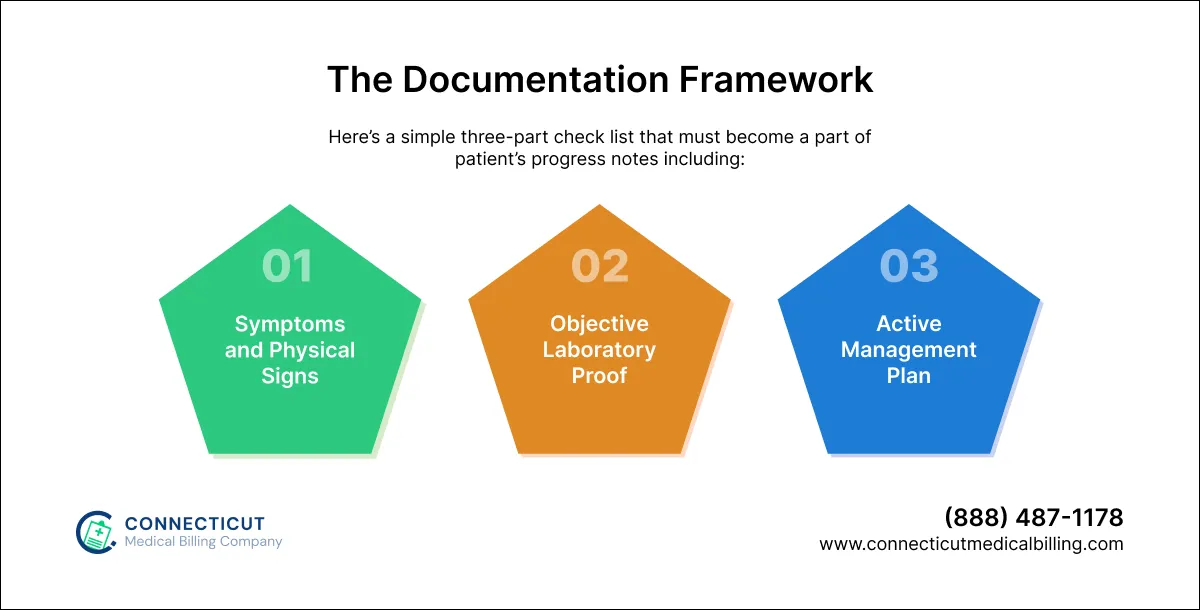
1-Symptoms and Physical Signs
Your clinical documentation must include the apparent symptoms the patient is experiencing like slowed metabolism, fatigue, weight increase/decrease, intolerance to heat or cold, dry skin and bradycardia, etc.
2-Objective Laboratory Proof
The second important step in the checklist is clear and detailed documentation of lab results indicating the presence of hypothyroidism by the identification markers like elevated or depressed Thyroid Stimulating Hormone (TSH), low normal free T4 levels to corroborate your diagnosis.
3-Active Management Plan
Your documentation must include the current treatment being used like hormone replacement therapy like Thyroxine titration or its maintenance dose along with a treatment roadmap with tentative expected therapeutic outcome, etc.
By applying this simple three part checklist, you can increase the accuracy in the documentation and meet compliance requirements.
CPT Pairing Best Practices: Matching Codes to Care
Even if your clinical documentation is perfect, use of invalid CPT or ICD 10 Hypothyroidism code can stall your revenue. Here how to make your coding selection error-free:
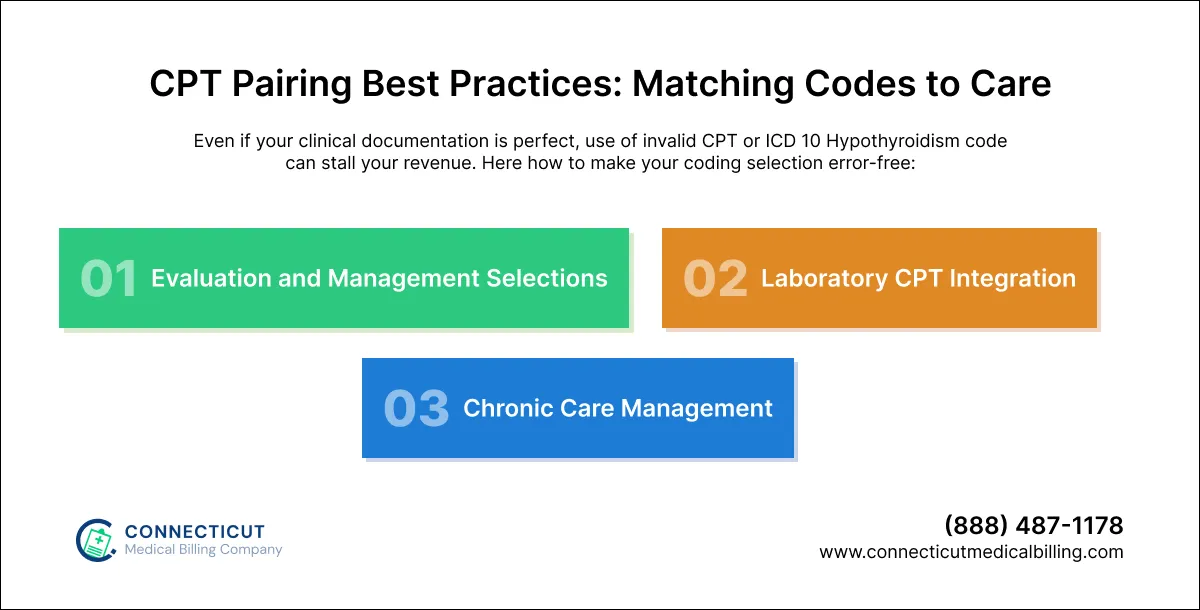
Evaluation and Management Selections
Hypothyroidism treatment hinges on correct ICD 10 hypothyroid code with evaluation and management code. If you’re seeing a patient with stable hypothyroidism, add the 99213 code to support your medical decision making for low complexity cases. However, when the patient’s condition is a moderate complex that requires occasional Thyroxine dose adjustments, then it’s appropriate to use 99214 CPT code for chronic illness care.
Laboratory CPT Integration
Not only do your E/M code must be aligned with Hypothyroidism ICD diagnosis code, but the lab results clearly link them to your clinical rationale. Here are the specific CPT code for laboratory tests:
- 84443: Thyroid Stimulating Hormone (TSH)
- 84439: Free Thyroxine (T4)
- 84481: Free Triiodothyronine (T3)
Adding these codes ensures payers understand the diagnosis proof of hypothyroidism and how the condition is managed. Doing this will help you expedite the reimbursement process.
Chronic Care Management
Finally, if your patient is a co-morbid, facing more than one medical issue, it justifies using the chronic care management code 99490. The use of this code shows the non-face-to-face care coordination for management of co-morbidities a patient is having and helps payers understand the complexities of thyroid disease.
Key Takeaway
Understanding the nuances of Hypothyroidism ICD-10 E03.9 ensures medical practices run perfectly aligned with payer reimbursement policies. By using the specificity codes for hypothyroidism in the presence of clear diagnosis, you can prevent costly denials. Similarly, the three part checklist helps you make the clinical documentation framework spotless and refined by accurate recording of symptoms, laboratory evidence and active management plan.
Lastly, you must match the ICD-10 code with E/M CPT code, laboratory screening codes and chronic care management codes like 99490 to capture existence of co-morbidities. By following these steps your billing staff can generate clean claims accepted at first submission. Doing this will help you get paid for all rendered services than being underpaid or worse investigated by a payer audit team.
If your practice is facing the issues in accurately billing patients and often underpaid for care services, then outsource your billing to Connecticut Medical Billing for seamless revenue cycle. Our staff will help you remove obstacles to cash flow, creating a seamless billing experience. Book your free appointment today.
Improve Your Medical Billing Today
Increase clean claims and get paid faster with expert billing support.