

In 2026, administrative lags are increasing patient financial responsibilities and it is becoming more difficult for practices to keep up with this challenge. Failure to collect even small amounts can become big over time if not tackled timely. Traditional methods for revenue collections are failing, prompting adoption to new methodology to keep accounts receivable lower in your ledgers.
Even with so many obstacles in the way, the good news is that you can improve your practice’s revenue cycle without overhauling the entire billing workflow. This guide contains 5 proven strategies to increase collection rates without compromising your financial health. You can take these steps to reduce friction between you and your patients and get measurable results in no time.
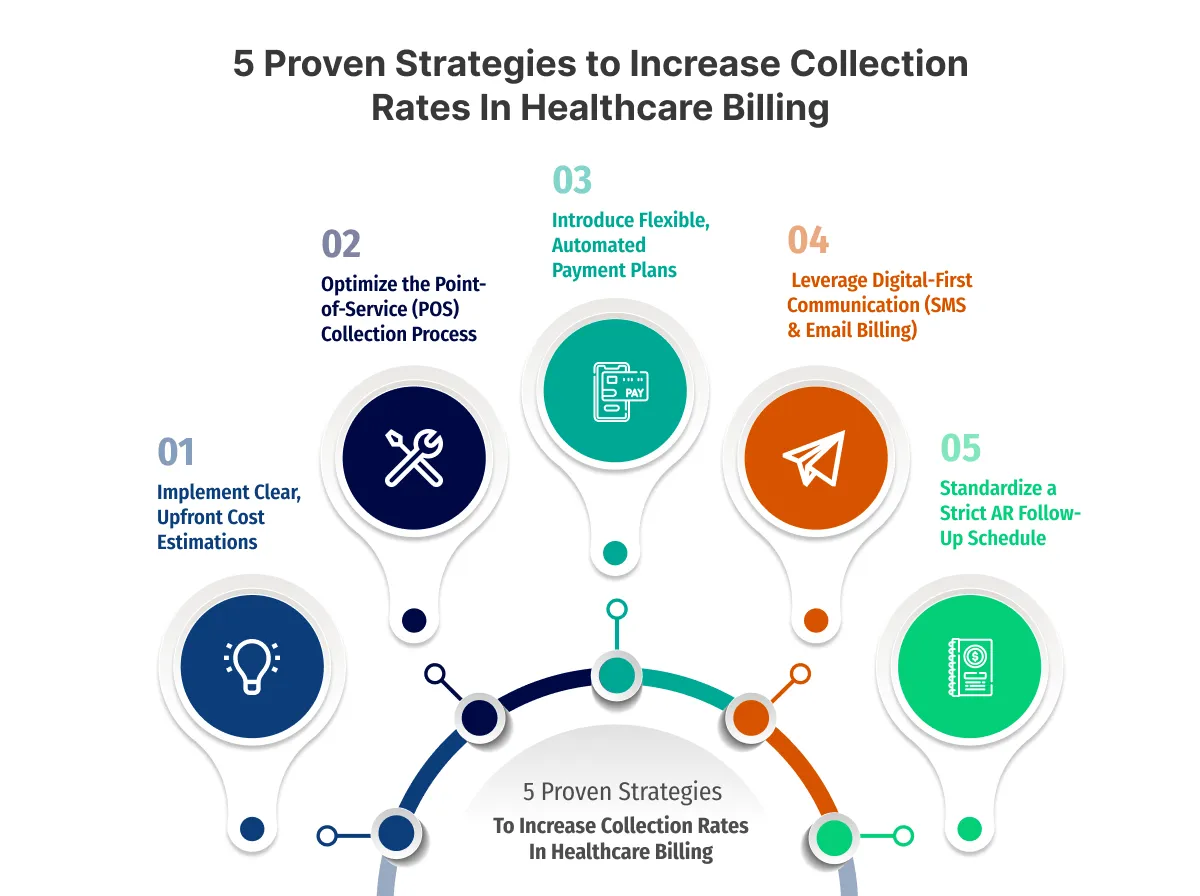
Strategy 1: Implement Clear, Upfront Cost Estimations
One of the best and easy to implement patient collection strategies to employ accurate and faster upfront cost estimation. Patients are more likely to pay their financial responsibility when they know the complete breakdown of the cost. Your team must do a thorough eligibility verification, covered and non-covered services, deductibles to determine how much patients have to pay for out-of-pocket costs.
Doing this will help minimize sticker shock and the patient will have complete information about procedure cost and whether to proceed or not. This strategy will not only foster trust between your practice and patients, but also reduces billing confusion.
Strategy 2: Optimize the Point-of-Service (POS) Collection Process
Strengthening and optimizing point-of-service collection is one of the best and most effective strategies to increase collection rates in healthcare billing. Train your team to follow a standard script before or right after the patient is examined for collection of co-pays, deductibles, and outstanding past-due balances.
Doing so will not only reduce the costs and time on mailed patient statements, calls and texts, it will also create a predictable cash flow. But if your team overlook this issue and the patient leaves the office, collecting even $10 becomes difficult.
Strategy 3: Introduce Flexible, Automated Payment Plans
One of the biggest obstacles in medical billing optimization is high deductible plans that patients cannot pay at once. Implement a card-on-file payment plan to facilitate clearing of outstanding balances. A clear AR policy of recovering all payments within 3-6 months to be followed for every high-deductible plan clear dues within putting your practice under financial burden.
Offer flexible payment plans for patients with remaining balance and automate the entire collection process with card-on-file technology by obtaining written consent from patients. Automation ensures your team work only on current billing tasks and improving patient experience than tracking past dues.
Strategy 4: Leverage Digital-First Communication (SMS & Email Billing)
Relying on paper mail and fax in 2026 can significantly increase the operational cost. Modern successful healthcare revenue cycles leverage the use of digital platforms where automated text-to-pay and email billing notifications offer direct payment links right at your patients’ smartphones, tablets or laptops.
Digital communication via email, texts reduces the paper and postage expenses and removes the slow and tedious process where your staff must wait weeks before a patient sends the check. Mobile-friendly collection strategies offer easy tap-to-pay options, reducing complicated processes, which patients happily follow than outdated ones.
Strategy 5: Standardize a Strict AR Follow-Up Schedule
Develop a clear and comprehensive AR follow-up policy to categorize 30, 60 and 90 days past dues. Your staff must send reminders when the payment delays pass the 15 days payment window, and use mediums like calls, text, email platform for communicating directly with patients.
Also implement a policy to follow claims that have more probability of recovery than the ones with low chances of recovery. A proactive accounts receivable approach prevents past dues from accumulating to become bad debts and promotes long term financial stability.
Conclusion
No doubt increasing revenue collection is the biggest challenge for healthcare practices in 2026. When your billing team fails to take proactive steps to collect patient dues, they accumulate and turn into costly write-offs. The strategies to increase collection rates in healthcare billing does not mean overhauling your entire revenue cycle. Implement these in steps and overcome AR delays, improve patient experience with a flexible card-on-file payment system.
Take proactive steps with structured AR follow-ups via emails, direct payment link texts so that patients can pay dues with simple instructions through their smartphone. Choose any two strategies that fit your billing workflow and evaluate the results to find the best solution. Taking calculated steps can provide a visible change in your revenue cycle and lower the AR days without compromising your financial health.
Are you struggling to find the best solutions to increase your collection rates? Contact Connecticut Medical Billing for tailored solutions for your practice and stable your cash flow with minimum disruption.