

As a physical therapy provider, you invest the time, energy, and money on buying the various equipment to offer therapeutic modalities. Yet, after doing all this, most of your claims are rejected, denied especially the CPT code range of 97010 to 97039, that are heavily checked and scrutinized by the payers. Any documentation gap or missed charges can result in the entire therapy provided by you becoming free in an instant.
This blog guide breaks down the 5 common billing errors for therapeutic modalities and what damage they are causing to your revenue cycle. Eliminating these errors is not just important but necessary for the survival of your practice and revenue cycle. By understanding the damage these 5 errors are causing will help you mitigate the revenue leakage.
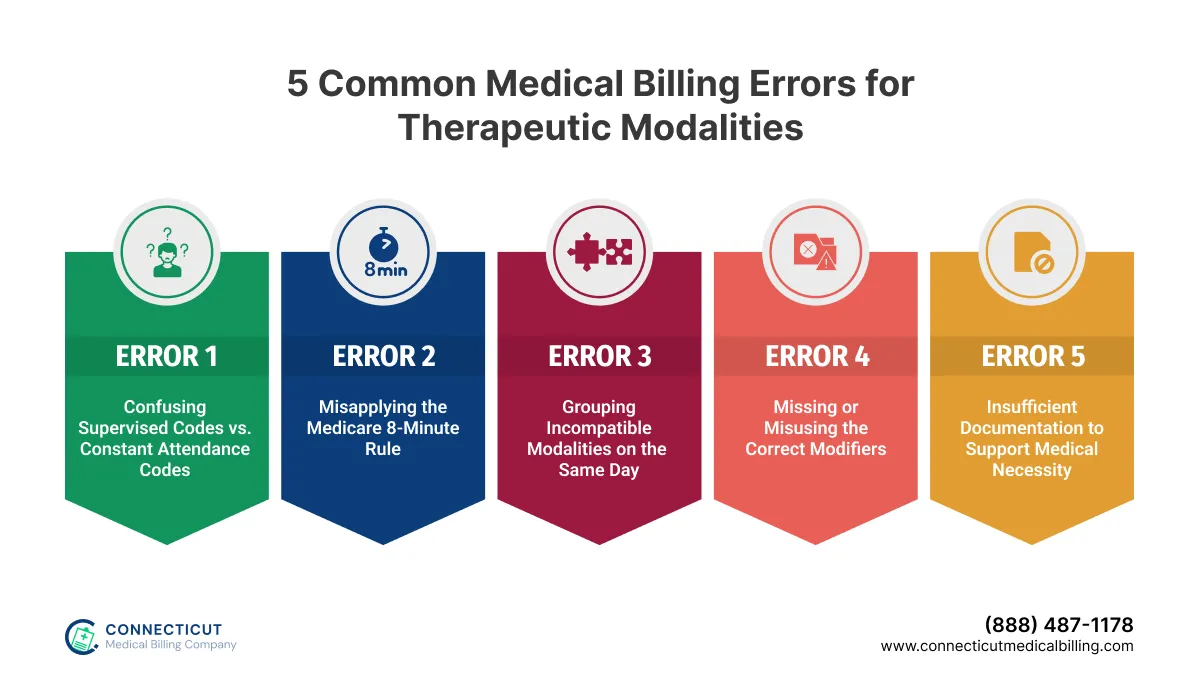
Error 1: Confusing Supervised Codes vs. Constant Attendance Codes
One of the most common and top medical billing errors pertaining to therapeutic modalities is confusing codes with constant attendance codes. This error constantly becomes a headache for providers.
Supervised Modalities (CPT 97010–97018)
Supervised modalities code apply on untimed services where provider’s one-on-one contact with the patient is not required or necessary. It includes hot/cold packs or mechanical traction, etc. Your clinical documentation must show that the modality was applied but constant provider presence was not necessary or required for the therapeutic outcome. These codes can be used to charge 1 unit per session irrespective of the time duration.
Constant Attendance Modalities Codes (97032–97039)
The constant attendance modalities codes range from 97032-97039 used for the first 15-min of therapeutic modality and then in increments. These CPT codes are specifically used when the provider is in direct contact with the patient through any means such verbal, visual or manual. Your clinical chart must be documented with the exact duration of the therapy session like ultrasound or manual electrical stimulation.
The Hidden Loss
Accidentally appending constant attendance code as untimed or vice versa, failing to document the required time by the provider can result in claim denial. When your claim is missing these important details, payers will automatically downcode it, resulting in underpayment for services.
Error 2: Misapplying the Medicare 8-Minute Rule
The second most common medical billing error revolves around misapplication of Medicare’s 8-minute rule:
The 8-Minute Threshold
Under the current Medicare’s 8-minute rule, a provider must remain present and directly deliver therapeutic modality under CPT (97032-97039) range to bill one unit of service. If the time is less than 8 minutes, then you cannot bill patients. Accurate tracking and recording of time is vital for reimbursement on therapeutic exercises.
The Hidden Loss
This financial damage occurs when providers mix the timed therapeutic modalities with other procedures like exercise, etc. When a medical billing team or provider fails to accurately document the time, or split the time incorrectly, total billing units are undercoded, resulting in partial payouts for services that should have been fully reimbursed. If your practice is facing this hidden loss, you’re exposing your practice to compliance risks.
Error 3: Grouping Incompatible Modalities on the Same Day
The third common billing error is related to charging insurance for multiple therapeutic modalities in one session:
The NCCI Edit Conflict
When providers charge insurance for multiple incompatible services like grouping hotpack (97010) with an ultrasound (97035) for the exact same muscle group can trigger claim denials due to violation of National Correct Coding Initiative (NCCI) edits. As soon as these erroneous claims are submitted, the payers flag them as redundant and open the door for audit review.
The Hidden Loss
When medical billing teams group together incompatible codes, insurance bundle the secondary therapeutic modality or deny it altogether as “not medically necessary”. This action results in medical practices bearing the full cost of secondary service. Physical therapists must make their documentation bullet-proof to protect their revenue from clawbacks, and follow NCCI guidelines religiously.
Error 4: Missing or Misusing the Correct Modifiers
The fourth medical billing errors related to therapeutic modalities include incorrect and misuse of service modifiers that stall revenue:
The Essential Modifiers
Even if the medical billing codes are flawless, many providers fail to apply accurate modifiers for two separately identifiable services provided on the same day or same session. When you have provided two distinct services use Modifier 59 (Distinct Procedural Service) along with other therapy services modifiers like Modifier GP (Physical Therapy), GO (Occupational Therapy), or GN (Speech-Language Pathology) for the two separately identifiable therapies. Failure to add appropriate modifiers can result in claim denial or underpayments.
The Hidden Loss
Omission or misuse of these important modifiers trigger automatic claim rejection and denials by the payer’s claim scrubbing teams. Additionally, missing modifier mistakes increases the AR days leading to cash flow obstruction and inefficiency.
Error 5: Insufficient Documentation to Support Medical Necessity
The fifth and mostly overlooked error is vague documentation that fails to justify medical necessity to payers:
The Documentation Standard
The new strict reimbursement policies have no space for vague clinical notes. A simple note in the claim like “applied ice and E-stim” is no longer sufficient, and acceptable by the payers. Insurance companies now require detailed notes on why the modality was chosen, failure of conservative therapy, specific frequency and setting of ultrasound, and body part treated by the provider.
Lastly, your notes must document what improvement can be expected in the patient’s life by your therapeutic intervention and how quickly functional goals can be achieved. When your clinical notes have that much level of clarity and details, payers have no reason to deny or downcode the claim.
The Hidden Loss
When your documentation is weak, copy and pasted, this may not cause immediate denial but it leaves your claim vulnerable to retroactive audits in the future. These hidden losses drain your practice’s time, revenue and effort, leaving the door open to non-compliance induced penalties, fines and loss of reputation. Your documentation must be solid and stand any payer scrutiny to demonstrate the services offered by your practice are medically necessary for the patients.
Conclusion
97010-97039 Therapeutic modalities range requiring precision in documentation and error-free modifier selection to pass through strict payer policies. With ever-changing payer policies and automated claim scrubbing, the billing team must work twice as hard for getting reimbursements. These 5 billing errors play a major role in almost 90% of claim rejections and denials.
Your RCM staff must understand the difference between untimed and timed modalities, the 8-minute threshold rule, NCCI edit conflicts for same-day therapies, using correct modifiers for separately identifiable services, and meticulous charting documentation to ensure your reimbursement is safe from clawbacks and review audits. Ensuring your staff is ready to match the new industry standards helps you evolve with the same pace as the payers. Taking all these steps will protect your revenue cycle and your practice for the long term.
Stop letting medical billing mistakes cost you a fortune. Contact Connecticut Medical Billing today to get tailored solutions that will help you stay focused on patient care and not paperwork. Get a free billing audit and discover how our experts reduce your claim denials effortlessly. Book your free audit!