

In the healthcare industry, every second presents a missed opportunity or gains in real-time. You’re a provider who has spent years in medical school and residency, but when your credentialing paperwork is slowed, it directly impacts your revenue cycle. For every patient you see until credentialing is finalized, you’re doing it at no cost.
In this blog, we will discuss and examine how credentialing delays impact your revenue cycle and what steps you can take to avoid them. Managing credentialing issues on time is not just important for your financial success; it also ensures you have professional autonomy.
The Invisible Leak: Why Credentialing is Your Personal RCM Foundation
Medical credentialing is the first step to ensure you’re a licensed medical professional who knows how to treat patients. This step is so crucial in the eyes of payors; without a CAQH profile, you are practically not a doctor until the verification process is completed.
The Missing Link: Your Work and Your Pay
If the link between your practice and insurance company is not established, you’re not getting paid. Whether you spend 12 hours in operation room, or see 50 patients a day, missing payor credentialing means you cannot convert clinical expertise into revenue.
The “Clean Claim” Myth
Even with the most skilled and certified medical billing staff, the credentialing gaps can still turn your meticulous claim into a denial. Every claim goes to the payor, must be submitted by a provider who is credentialed and enrolled in their panel. Once you’re credentialed, you can see patients without any issue and increase your revenue with ease.
4 Direct Ways Credentialing Delays Impact Your Professional Bottom Line
Delays in the credentialing process can affect your practice in the following ways:
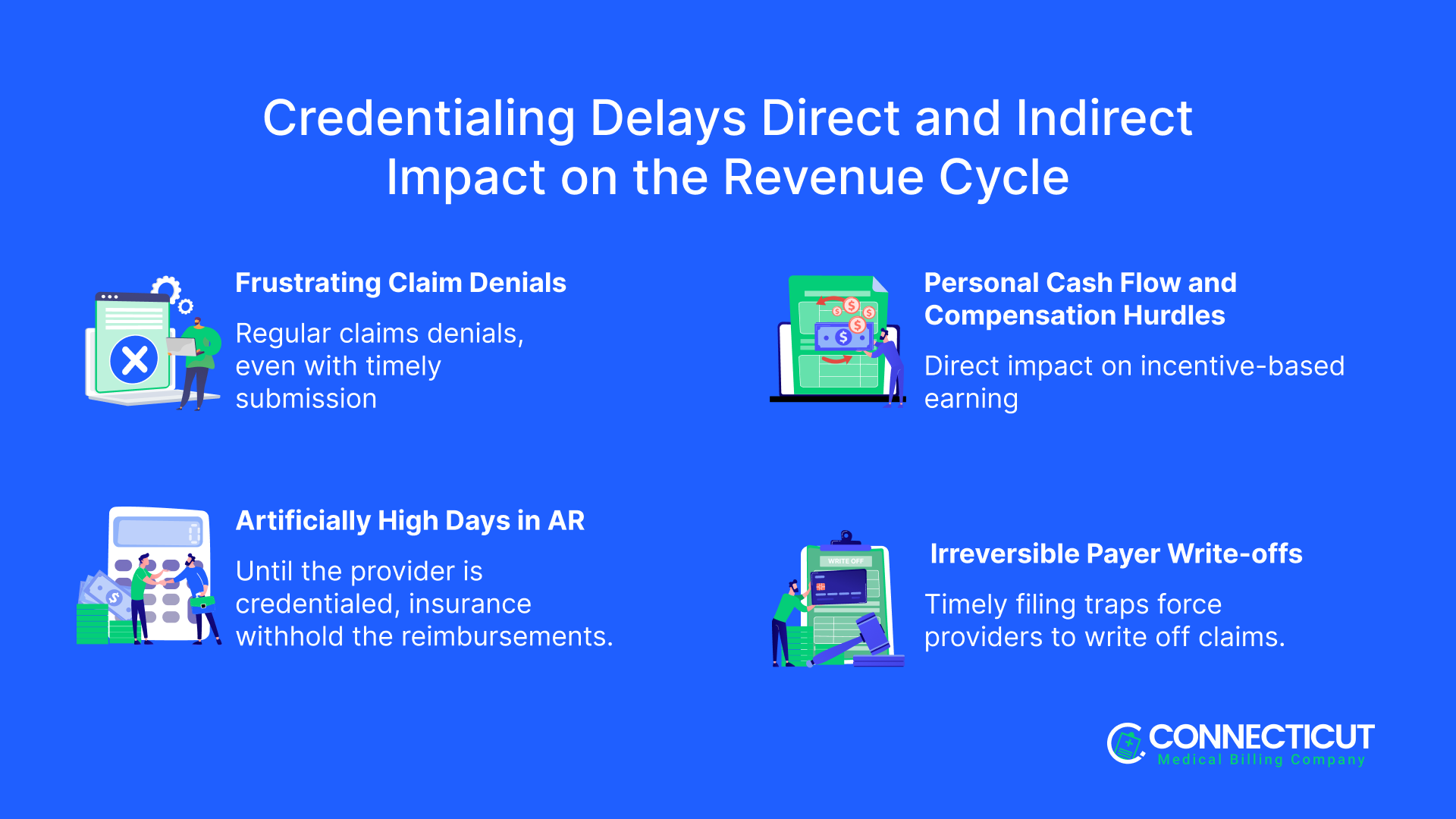
1. Frustrating Claim Denials
Nothing frustrates you more than seeing your hours of hard work wasted by the payer’s comment, “provider not enrolled.” These medical billing bottlenecks force your team’s attention to administrative failures, costing you an average of $30 per claim.
2. Personal Cash Flow and Compensation Hurdles
For providers working in group and solo practices, credentialing revenue impacts their RVU-based incentives (relative value units). This not only leads to lower expected earnings but also increases the economic stress on your practice, leading to delays in staff salaries and benefits.
3. Artificially High Days in AR
Pending enrollment applications stall your healthcare cash flow; even when you see hundreds of patients, the dashboard shows zero collections. This setback leads to lower profitability and eventually declining financial health.
4. Irreversible Payer Write-offs
Provider enrollment delays can turn into bad debts and costly write-offs. If you have missed the “timely filing” window, the service you performed will become unbillable, leaving you empty-handed.
The Ripple Effect: Beyond the Balance Sheet
The delays in credentialing can impact your revenue cycle management (RCM) in many ways other than financial stagnancy and claim denials:
Provider Frustration and Burnout
Provider frustration doubles when they can see patients, but insurance refuses to pay for the services. Administrative limbo that keeps clinicians away from seeing patients or shadow other until their credentialing is finalized leads to career dissatisfaction.
Compromised Patient Experience
Credentailing delays can erode a patient’s trust and experience over your clinical services. If you’re not credentialed, the entire service cost is billed to the patient, leaving them shocked by out-of-pocket costs that the insurance should have covered.
The Hidden Costs of Delays
Beyond the damage to your revenue cycle management, the hidden costs of credentialing bottlenecks are following:
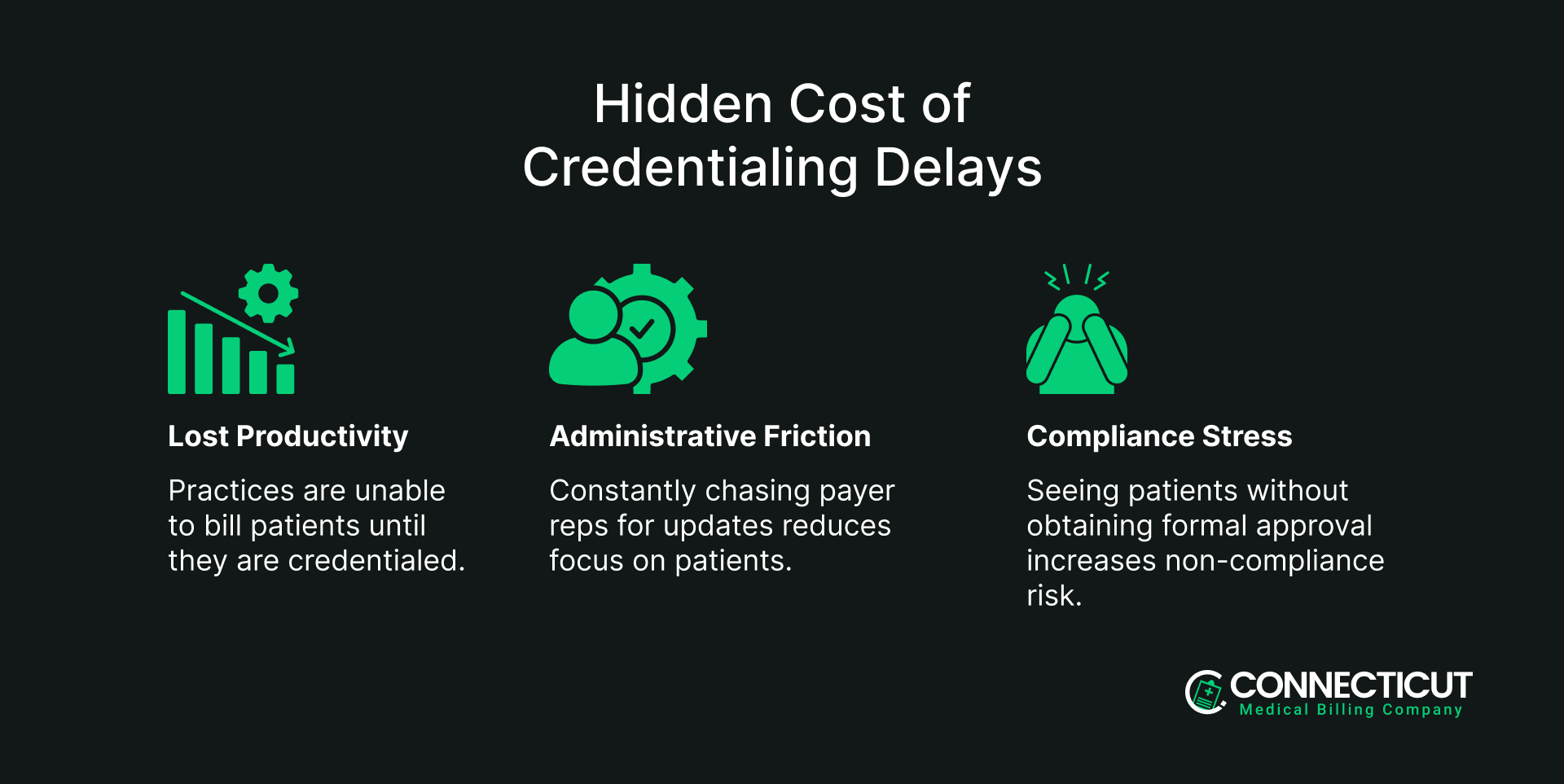
Lost Productivity
As a provider, every day you spend uncredentialed results in zero revenue. Under payer policies, you cannot bill a patient until your credentialing is approved. Without approval, there is no patient and no revenue.
Administrative Friction
Providers and their staff have to constantly chase the payer’s team regarding status updates with consistent back-and-forth emails/calls. This takes you away from patient care and requires you to spend energy on nonessential tasks.
Compliance Stress
Providers going through credentialing delays can face legal and compliance issues if they practice without obtaining clearance from payers.
Strategies to Protect Your Practice and Revenue
The proactive, time-tested, and highly useful strategies to minimize revenue loss and payer compliance issues are:
The 120-Day Head Start
It’s no secret that credentialing is a time-consuming process, typically taking 90+ days for initial approval. It’s best to start early and complete all steps to ensure they are followed. For hospital managers and administrators, process the new provider credentialing request 120 days before the onboarding time. This will give them plenty of time to rectify any issues arising during the processing stage.
Proactive CAQH Management
Please manage your CAQH profile with the utmost importance. Please update it regularly and include re-attestation of academic, professional, and DEA licenses. The use of credentialing software can reduce errors in the application request and fast-track the onboarding process.
Knowing When to Outsource
Partner with expert credentialing experts to help expedite credentialing approvals, so your team doesn’t have to spend hours every day talking to payer reps. Outsourced credentailing teams usually have already established relationships with payers, and know their policies. This helps you bypass many roadblocks.
Real-World Impact
To illustrate how the credentialing delays impact your revenue cycle, here’s an example that will help you understand:
Case Example
A provider joins a new group practice in a mid-sized clinic and submits all the required documents required by payers. The delay in approval has dragged on for more than five months. During this time, the provider sees hundreds of patients, but the clinic’s billing team cannot charge payers, trapping thousands in pending claims, which are already becoming bad debts.
Quantifying the Losses
Suppose this provider was seeing 100 patients per week and charging $80 per visit, that’s $8000 in claims in a single month, that carry no guarantee to be paid by payers if the claim filing window was 3 months.
Ripple Effects
The financial strain on the medical practice crosses $40,000 for five months, meaning the clinic’s staff will get late or no salaries, compromised quality of care services to patients, and many more, if the situation is not rectified.
Conclusion
Credentialing is the foundation of a healthy revenue cycle. As we have discussed above, starting your practice is the first step, but it doesn’t bear fruit if you’re not credentialed. Early planning, use of automation tools, and outsourcing are a few steps you can take to minimize delays in this process.
Don’t let administrative inefficiencies put a burden on your financial health. Take proactive steps to avoid costly denials and write-offs with better planning. Take the first step in keeping your credentials up to date and ready for onboarding with any payer you choose. Connecticut Medical Billing has decades of experience in managing credentialing and enrollment applications for providers across the US. Let us handle the lengthy paperwork, and you take care of patients. We will ensure every encounter is paid in full.