

ABA practices run on a tight margin where every claim is rigorously monitored by the payers for 15-minute unit application and accurate CPT coding. Providers have to balance the quality of care with strict adherence to documentation and prior authorization requirements set by the insurance. When denials turn into aging backlogs of account receivables, you must decide to either invest in hiring, training of your in-house team, or partner with an ABA therapy billing company to make your cash flow more predictable.
This guide breaks down the advantages and costs of outsourcing autism billing services vs utilizing the services of in-house billing teams. This blog will help you make the right decision keeping in view the challenges you face and how you can come out of them.
Option A: The True Cost of In-House ABA Billing
While maintaining autism revenue cycle management in-house seem more feasible and beneficial, but it has many disadvantages as well:
The Appeal of In-House Management
For many practices and hospital directors, in-house ABA therapy billing feels appealing because it offers you greater oversight on the billing and coding practices. It also allows close coordination between the therapist and the medical billing teams. Additionally, maintaining an in-house billing staff allows practices to customize the insurance claim management workflow as per the needs of the facility.
The Financial Reality
While the in-house billing team looks more appealing. The entire picture changes when we assess the actual cost of medical biller salary vs outsourcing by dissecting the apparent and hidden costs, etc.
Salary vs. Total Employee Cost
A qualified and experienced autism billing expert can earn between a base salary of $50,000–$60,000 per year. However, when you add additional costs like paid time off (PTO), benefits, clearing house fees and proprietary EHR software license fees, the total cost goes above $70,000 annually.
Fixed Overhead
The fixed salary expenses remain constant regardless of the seasonal patient drops and referrals, your practice has to absorb these costs by all means. This makes the billing scalability more of a challenge.
Operational and Turnover Risks
Running all billing operations in-house exposes your autism practice revenue cycle to unique vulnerabilities like:
Single-Point-of-Failure
In-house billing pushes your practices more towards a single point of failure where ABA billing team turnover or sick leave completely stalls your revenue cycle. This results in claim generation, submission and collection process in limbo.
The Continuous Training Burden
CMS and commercial payers frequently update the autism and ABA CPT codes 97153 97155, etc. These periodic coding updates require your in-house coding staff to stay current and vigilant whenever such changes occur. Arranging the training sessions for improving healthcare billing compliance adds another layer of costs that you must pay from your earnings. All of the above mentioned costs make the in-house billing more of a financial liability than an asset.
Option B: The Mechanics of Outsourced Autism Billing
On the other hand, medical billing outsourcing offers various benefits that in-house billing team cannot:
The Strategic Appeal of Outsourcing
Outsourcing ABA billing services for Autism therapy help you lower the fixed operational cost into a variable cost, fixed to your practice’s growth. Instead of your practice bearing all the cost of staff’s salaries, benefits and seasonal dips, you only pay for the basis of claim processed or at a certain mutually agreed percentage in the contract.
The Financial Model: Performance-Based Alignment
A specialized outsourced billing company for ABA therapy clinics typically operate on performance based pricing between 4-8%. This means that you get to pay them a certain percentage of your revenue and lower the ABA claim denials significantly. In contrast with fixed monthly salaries where you must pay whether patients visit your clinic or not, outsourcing protects your margins even when patient volume drops.
Core Operational Advantages
Partnering with an expert applied behavioral analysis (ABA) billing firm helps your practice to achieve operational and financial resilience:
Built-In Redundancy & Continuity
Outsourced autism billing teams have built-in support systems for redundancy and continuity to offer all-weather support. If your assigned account manager takes a leave, the workflow doesn’t get affected and continues without interruption.
Proactive Prior Authorization Management
Outsourced medical billing staff understand the nuances of different payers you work with and obtain advanced prior authorization for autism therapy to make the patient experience smooth. Getting prior auth 24-48 hours in advance helps minimize claim denials and costly write-offs.
Reduced First-Submission Denials
Additionally, outsourced autism billing services utilized state-of-the-art claim scrubbing tools that detect anomalies in ABA CPT codes, missing modifiers and medical necessity gaps to accelerate the reimbursement process.
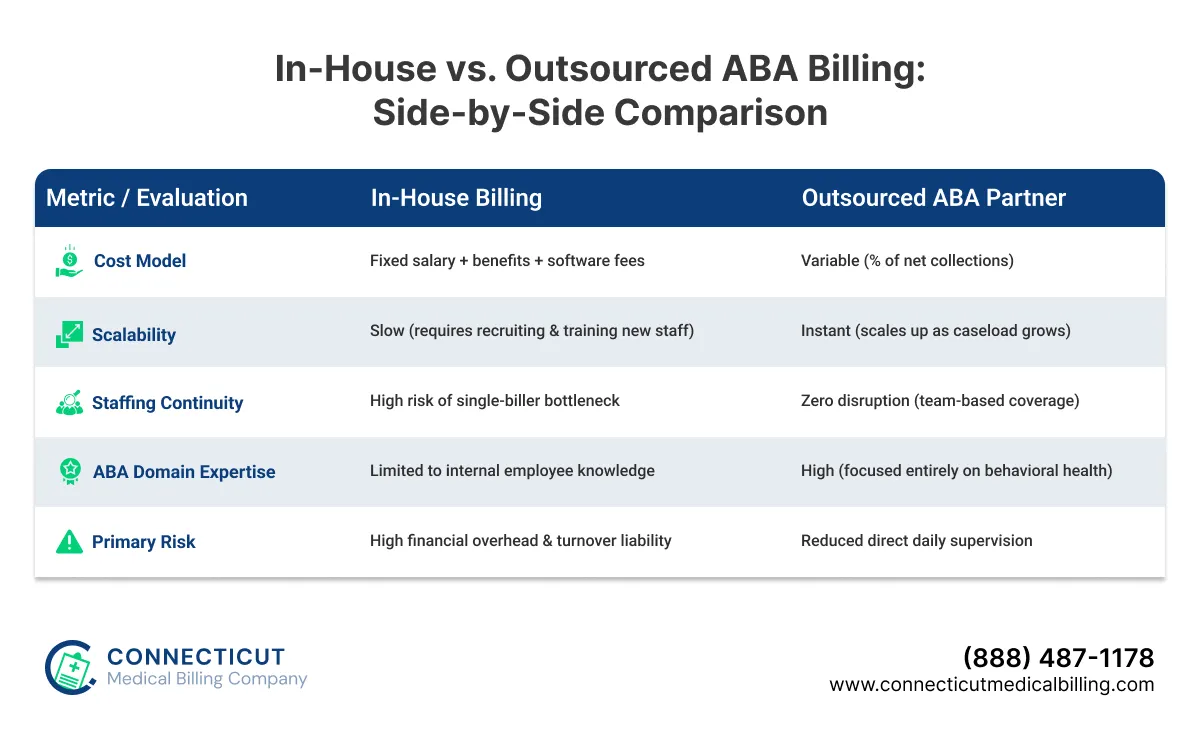
In-House vs. Outsourced ABA Billing: Side-by-Side Comparison
For ABA providers and hospital managers, the following is a clear head-to-head comparison of in-house billing with outsourced company for scalable behavioral health billing operations:
Decision Framework: Which Model Fits Your Practice?
When choosing between in-house billing vs outsourced RCM billing partner, is it important to consider which framework suits your billing needs:
When In-House Billing Makes Sense
An in-house ABA therapy billing team is only feasible and logical for large and multi-specialty clinics that have substantial capital to manage fixed overhead costs. Beside having finance to support in-house teams, they also have dedicated HR department, multi-state practices, credentialing staff and training protocols in place to absorb such financial burden.
When Outsourced Autism Billing Makes Sense
Choose to outsource your billing when your autism therapy practice falls into the following categories:
Solo BCBAs and Small-to-Midsize Clinics
If you’re a solo practitioner or running a small to medium-size clinic where you face cash flow instability and want to reduce the administrative burden on your staff.
Rapidly Scaling Practices
If your clinic is experiencing a rapid growth in patient intake and in-house billing staff is overburdened and lacks clinical expertise to meet the scaling requirements of your facility.
High Aging A/R
Practices with aging accounts receivable struggling to lower the backlog can choose a dedicated denial management team to restore billing efficiency and improve revenue cycle.
Conclusion
Choosing between the in-house vs outsourced autism billing services comes down to your practice’s requirements and long term financial strategy. While both options offer benefits, where in-house staff offers direct face-to-face communication, oversight and control on the pace of the billing team. On the other hand, the outsourced ABA billing team lowers the fix-cost related to monthly payroll and benefits expenses.
Partnering with a professional medical team agency allows you to scale your practice with the rising demand of the healthcare industry. This way your revenue stays protected and predictable, ensuring growth stays on track irrespective of the payer scrutinies. Are you ready to optimize your practice cash flow and lower the operational costs? Connecticut Medical Billing offers free ABA billing audit so you get excellent RCM services and billing expertise to lower claim denials. Book your free appointment today.