

In the modern healthcare industry, the silent killer is low or stagnant patient collections. These issues not only result in long hours for chasing claims, but also affects the patient’s care. The negative effects on your staff shows administrative burnouts, and erroneous billing. Clinical efficiency can only be maintained when your claims are submitted and reimbursed timely.
In this blog, we will discuss the best strategies for increasing patient collections medical practice should adopt. We will help you transform your revenue cycle management into an efficient cash flow engine, improving the financial health as quickly as your patient’s symptoms.
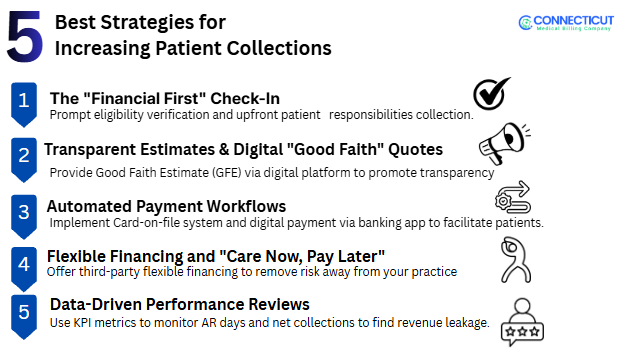
Strategy 1: The “Financial First” Check-In
One of the most effective strategies for increasing patient collections is initiating financial discussion at front-desk. Your team should be trained in starting the conversation when the patient checks-in. This preemptive effort can help you reduce administrative burden and time that would otherwise be spent on chasing patient dues.
Proactive Insurance Verification
To implement a front-desk collection strategy, your staff should perform Real-Time Eligibility (RTE) verification to every appointment before you see the patient. Obtain information like copays, coinsurance, deductibles a minimum of 24 hours prior to patient check-in. This way your team will know the benefits and inform patients upfront what they must pay before being allowed to enter your room.
Point-of-Service Collections
When your billing staff has all the information related to eligibility and benefits covered under the health plan, it’s best to collect co-pays and any outstandings right at the check-in time. This way you can reduce administrative burden on the back-end office and save the value time for costly paper statements, calls, mails, etc. Implementing this step can effectively increase your patient collections by a minimum of 30%.
Strategy 2: Transparent Estimates & Digital “Good Faith” Quotes
Integrating transparency into service pricing helps you mitigate patient doubts and dissatisfaction. Patients are more likely to clear their dues upfront if they know for what service they are paying it for. Right after the patient enters your clinic and is greeted, the front desk must inform them the total cost of the encounter and procedure. A clear breakdown of the percentage covered by insurance and out-of-pockets cost builds trust between your practice and patients.
Leveraging Automated Cost-Estimator Tools
Leveraging automated cost-estimator tools helps your team in managing patient payments. Integrate these tools with your practice management software for every procedure partially covered or not covered by insurance. Provide a Good Faith Estimate (GFE) to keep patients informed about services cost. This will help build transparency and patients will likely pay for services they know the cost of.
Digital Delivery for Faster Buy-In
Providing Good Faith Estimate (GFE) using digital platforms like WhatsApp, email, text, etc make it easier for patients to access the cost details. It helps practices build trust in care services and retain patients in the long term.
Strategy 3: Automated Payment Workflows (The “Set It and Forget It” Model)
In 2026, if your billing system is not running on automation, you’re missing out on a big advantage. Still doing manual billing doubles the administrative burnout on your staff, diverting their attention on paperwork and statements than improving patient experience. Medical billing automation allows the tools to do the heavy lifting like catching billing errors, reminders for past dues and appointments.
The “set it and forget it” practice management model helps you cater the patient’s needs and require minimal human intervention.
Securing Revenue with Card-on-File (CoF)
To keep the account receivable at minimum level, implement a Card-on-File (CoF) system that helps you charge patients for unpaid balances. Obtain written consent from patients and securely store the financial details. This will help you recover the copay amount and save the patient’s time on future payments.
Utilize Digital Payment Reminders
Most payments are done now using mobile apps like Google Wallet, ApplePay, etc. Integrate these omnichannel payments into your billing system and help patients pay their bills on-the-spot using mobile apps. This strategy will reduce your collection time by more than 90% and free your back-office staff from calling patients to clear dues.
Also, set up a system for reminder automation to keep your patients informed on their dues and the last date of clearing payments. This way a prompt communication channel can be developed between patients and your billing team, minimizing confusion.
Strategy 4: Flexible Financing and “Care Now, Pay Later”
One of the biggest challenges for patient collections in medical billing is emergency cases, where irrespective of a patient’s financial situation, you have to treat them. These account receivables accrue over time and become bad debts.
Opting for “Care Now, Pay Later” options, you can ensure patients receive the urgent medical care without compromising your practice’s revenue.Your practice can gain new patients while also managing cases where upfront patient collection is not possible.
Third-Party Medical Financing
One best option to safeguard your patient collections is offering third-party financing to your patients. Train your billing staff to offer such service to patients before check-out so they have a credit option to pay you indirectly. This risk mitigation strategy helps you keep bad debts away from the practice.
Preserving the Provider-Patient Bond
Outsourcing the patient collections to a reputable medical billing company can help you focus on just patient care and let experts take control of patient debts. Separating your practice from patient dues collection duties reduce administrative burden significantly. This step allows your entire staff to play a vital part in improving clinical outcomes rather than working on account receivables.
Strategy 5: Data-Driven Performance Reviews
Perform regular audits to find the pattern of patient collection delays with defined industry standards. Track KPIs and move your collection process from outdated guesswork to data-backed insights. Doing this will provide you a holistic view of the revenue cycle and where it’s lagging behind.
Tracking performance metrics like total patient check-ins, collections through deductibles, co-pays, co-insurance can provide you clarity and suggestions for improvements. Having data-backed insights helps you employ a targeted solution approach, ultimately, lowering administrative burden and frustration over missing collections.
Monitoring Days in A/R
AR days help you understand the entire revenue collection cycle, from the day claim is sent to payers to the day money is received in your bank. If it is above 30 days, it’s a red flag and requires your team to inspect late reimbursement.
Analyzing Net Collection Rate
Similarly, monthly net collections reviews help you measure the exact percentage of total collections from patients and insurance companies. Systematic review will reveal where the revenue is leaking and what steps you can take to stop these leaks. This will help your team to improve their claim processing methods and lowers the administrative burden.
Conclusion
Revenue cycle optimization is a challenge that requires taking precise and calculated steps to ensure a better financial health of your practice. In this blog, we have presented you with 5 best strategies for increasing patient collections. You can significantly improve your revenue by improving front-desk collections, offering good faith estimates, implementing card-on-file systems, third-party financing and tracking KPIs.
Implementing these strategies will not only increase your patient collections, but also reduce the administrative burnout caused by chasing claims. Good Faith Estimate automation enables you to clearly discuss the costs of the procedures, helping patients understand their financial responsibility. In the end, when the patient knows the full cost and importance of paying upfront, you will gain their trust and create a healthy cash flow.
Is your patient collections causing revenue leakages and frustrations? Connecticut Medical Billing can help you lower your administrative burden and operational costs. Our certified staff will ensure every minute you spend in office is paid in full.